Why your brain remembers a swoosh before it remembers your neighbour’s name , and what every marketer desperately needs to understand about the machinery of memory.
Think about the last time you were thirsty . You didn’t scroll through options in your head. You didn’t weigh ingredients or compare labels. One image just arrived. A particular red. Round, cold, familiar. Already there before you’d finished the thought. That’s not a coincidence. That’s years of quiet, persistent work done directly on your memory and you never once noticed it happening. That effortless surfacing has a name: brand recall.
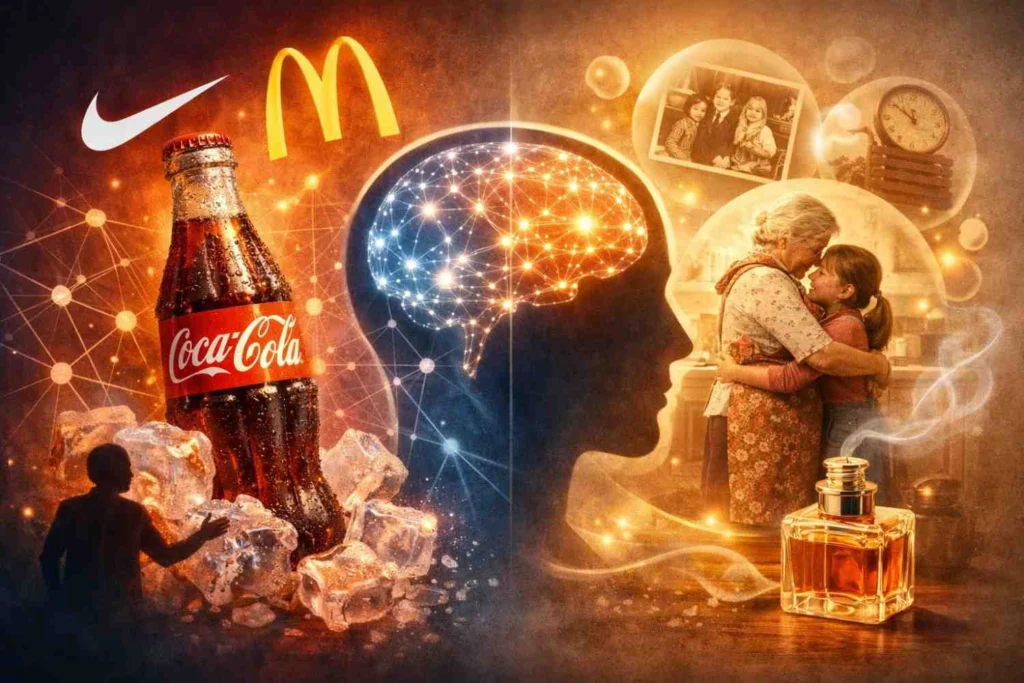
if you smell your grandmother’s perfume and suddenly you’re seven years old, standing in her kitchen, hearing the specific sound her bangles made. You didn’t try to remember any of that. It just came , all at once, carried by a single scent. That’s how memory actually works. Everything you ever experienced is woven together sounds, smells, emotions, places, faces, feelings you can’t even name. Psychologists call it spreading activation. The simpler way to say it is this nothing lives alone in your heads.
Brands figured this out. When a company repeats the same colour, the same sound, the same feeling across years of advertising, they’re not just trying to look consistent. They’re stitching themselves into your associative web becoming a neighbour to emotions and moments that already matter to you. This is the quiet engine behind strong brand recall: not loud advertising, but deep root in memory.
And this is precisely why brand recall is so different from brand recognition. Recognition is passive ,you see a logo and confirm you’ve seen it before. Recall is active. You summon a brand from nothing but a feeling, a moment, a need. That requires a brand to have genuinely moved into your memory, not just visited it.
“A brand that lives only in recognition is a guest. A brand that lives in recall has moved in.”
Repetition
The first thing most people reach for is repetition. Show an ad enough times and people will remember it. That’s not wrong but it’s dangerously incomplete.
In the 1970s, psychologist Robert Zajonc showed that simply being exposed to something repeatedly tends to make us feel more warmly toward it even when we don’t consciously recognise it. Brands benefit from this. But here’s what most marketers skip over: Zajonc also found that the effect plateaus. And it works best when there’s some variation in the exposure. Show the exact same thing enough times and the brain stops registering it. It becomes wallpaper. The brain habituates and habituation is the quiet death of memory.
We Remember What We Feel
Neuroscientist Antonio Damasio once studied patients who had lost the ability to feel emotion due to brain damage. What he found was surprising: they couldn’t make decisions. Not difficult ones, not simple ones. Without emotion, even choosing what to eat for lunch became impossible.
His conclusion was radical and uncomfortable for anyone who believed humans were purely rational creatures emotion isn’t a distraction from good thinking. It’s the foundation of it.
For brands, this changes everything. The brain’s emotional centre, the amygdala, sits right next to the hippocampus the part responsible for forming long-term memories. When you feel something strongly, the amygdala essentially taps the hippocampus on the shoulder and says: remember this. The more emotion an experience carries, the more firmly it gets pressed into memory.
We don’t remember what we saw. We remember what we felt. A brand that makes you feel something , anything real ,isn’t just more likeable. It’s physically more likely to live in your long-term memory. That’s not a metaphor. That’s neuroscience.
It’s also why storytelling took over brand communication. A story creates anticipation, tension, and resolution. It takes you somewhere. A list of product features, however accurate, does none of that. The hippocampus files it under things that didn’t matter.
The Nostalgia Lever: When brands tap into nostalgia, they’re borrowing emotional power from memories you formed during the most vivid periods of your life adolescence, early parenthood, landmark moments. Those memories were encoded with unusual intensity. A brand that anchors itself to that era gets to ride that emotional charge every single time it’s recalled. It’s not sentimentality. It’s strategy.that is brand recall
The Hooks You Don’t Notice
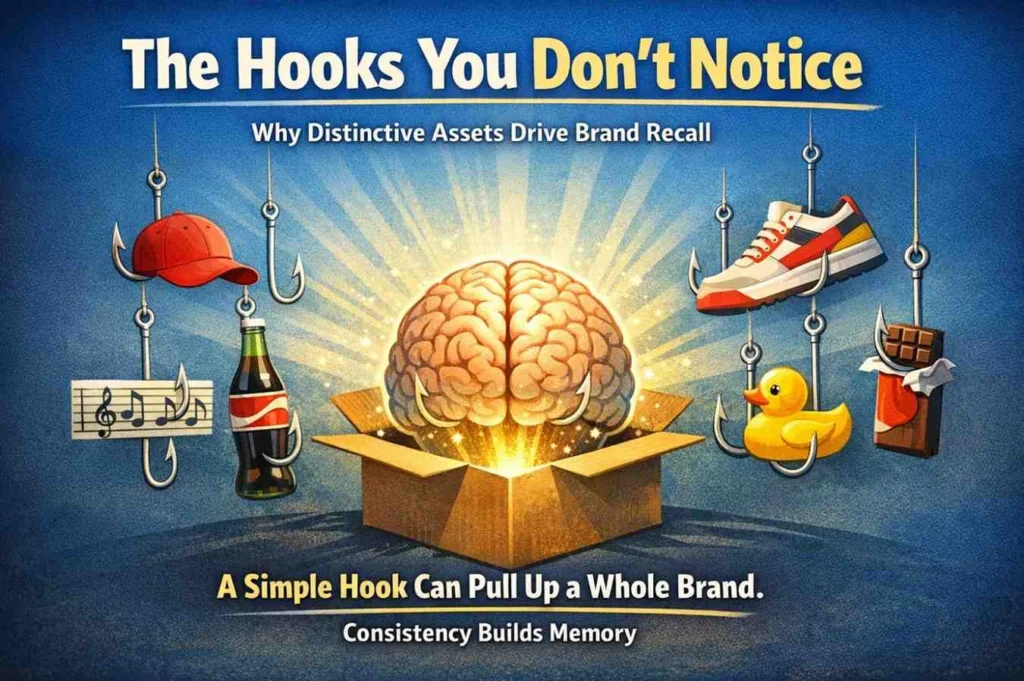
Brand researcher Byron Sharp introduced the idea of distinctive assets the specific sensory cues a brand owns in the minds of people. A particular shade of blue. The shape of a bottle. Five notes of music. A typeface. A character. Each one is a hook embedded in memory, and encountering any single hook can pull the whole brand to the surface even without the name being present.
The catch? These hooks only work through consistency. Every time a brand scraps its visual identity in search of feeling “fresh,” it risks dismantling hooks that took decades to build. There’s a psychological principle behind this called encoding specificity we recall things most reliably when the cues available at the moment of recall match the cues that were present when the memory was first formed. Change the cues, and the memory becomes harder to reach.
This is the uncomfortable truth that sits at the heart of strong brand recall: the brands people remember most easily are almost never the ones that changed the most. They’re the ones that had the discipline to stay recognisably themselves.
Being There at the Right Moment
Brand recall doesn’t happen in a boardroom. It happens at 3pm on a Tuesday when someone is thirsty, or tired, or quietly planning a trip they haven’t told anyone about yet. It happens at the exact moment a person realises they need something.
The brand that surfaces in that moment without being searched for, without being compared is the brand that wins. Often without the consumer doing another second of research.
The most sophisticated brand strategies aren’t built around values or mission statements. They’re built around moments. The goal is to wire the brand so deeply into the feelings associated with a particular need or occasion that when that moment arrives, the brand simply fires. Automatically. Before logic even enters the room. It is, in the most literal neurological sense, Pavlovian conditioning applied to everyday commercial life.
Being Remembered Is Not Enough
One final thing worth saying plainly: strong brand recall doesn’t automatically mean people like you. A brand can be instantly recalled and widely avoided. The memory exists, it just comes loaded with the wrong feelings.
So the real ambition isn’t simply to be remembered. It’s to be remembered warmly. At the right moment. In the right context. With the kind of feeling that moves someone toward you rather than away. That combination salience and sentiment, working together, consistently reinforced is what separates a brand that occupies market share from one that genuinely occupies a place in people’s lives.
“The best brands are not recalled. They are anticipated.”